 330-757-3569




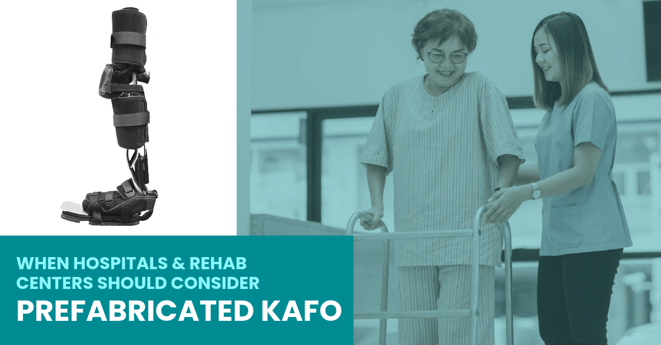
A prefabricated KAFO is a pre-manufactured knee-ankle-foot orthosis that combines knee and ankle-foot components in an adjustable system. Hospitals and rehabilitation centers may consider one when a patient requires coordinated support above and below the knee and when an available modular configuration can meet positioning, stability, mobility, and professional fitting requirements without waiting for custom fabrication.
A knee-ankle-foot orthosis (KAFO) may be considered when ankle-foot or knee bracing alone does not provide the control required for standing, walking, positioning, or rehabilitation activities. In acute rehabilitation, skilled nursing, and hospital workflows, a prefabricated option can provide an alternative within limited treatment timelines, but availability should not outweigh fit, function, or follow-up.
At Anatomical Concepts, Inc. (ACI), we manufacture both prefabricated and custom orthotic solutions for medical professionals. Our modular prefabricated KAFO systems combine selected knee and ankle-foot orthoses that can be professionally custom-fitted and adjusted to accommodate changing rehabilitation needs, whether the patient is ambulatory or at rest.
Prefabricated vs Custom KAFO: How the Options Differ
The prefabricated vs. custom KAFO decision should reflect the patient’s anatomy, presentation, anticipated progression, and required level of control.
Under Medicare coding guidance, both off-the-shelf and custom fitted orthoses are classified as prefabricated. However, the terms are not interchangeable: an off-the-shelf orthosis requires only minimal self-adjustment, whereas a custom fitted prefabricated system requires more extensive modification by a professional with specialized orthotic expertise.
ACI’s prefabricated KAFO braces are designed to be trimmed, bent, or otherwise modified by a licensed health professional or other qualified expert for custom fitting. Our modular KAFO systems combine posterior-jointed knee and ankle-foot orthoses, and the individual sections can be disconnected quickly and without tools for separate use, if necessary.
A custom KAFO may be more appropriate when no available prefabricated configuration can provide the required fit, tissue protection, alignment, or multi-plane control. Medicare coverage criteria also identify inability to fit a prefabricated orthosis, long-standing need, tissue-injury prevention, and certain healing fractures among the circumstances that may support custom-fabricated AFO or KAFO coverage. These payer-specific requirements do not replace clinical judgment.
The custom KAFO vs. prefab KAFO decision is not a quality ranking, nor should it be based solely on how long the orthosis will be used. A prefabricated system may serve as either an interim or long-term orthosis when it continues to fit properly and support the patient's functional goals. Conversely, custom fabrication may be more appropriate when available prefabricated measurements, component options, or levels of control cannot adequately achieve the required fit, alignment, or functional control.
When Hospitals and Rehab Centers Should Consider a Prefabricated KAFO
When Knee Control is Needed Beyond an AFO
The question of when to prescribe a KAFO begins with whether the patient needs coordinated management above and below the knee. A KAFO for knee instability may be considered when an ankle-foot orthosis or knee orthosis does not provide sufficient control during standing or walking. Current Medicare coverage language similarly addresses KAFO use for ambulatory patients who require additional knee stability.
Depending on the selected ACI components, orthotic applications include:
-
Postoperative use
-
Fracture and contracture management
-
Lower-extremity rotational control
-
Suspension
-
Interim or long-term management for patients with stroke, traumatic brain injury, spinal cord injury, multiple sclerosis, or cerebral palsy.
When the Need Emerges During Acute or Early Rehabilitation
In acute rehabilitation hospitals and skilled nursing facilities, a KAFO or AFO need may be identified while range of motion, strength, functional abilities, and therapy goals are still being assessed. A readily available system can help the team respond within a limited inpatient timeline when the available configuration fits the patient and supports the treatment plan.
Our prefabricated KAFO and AFO modular orthotic systems are immediately available, while some product variations are specialty items with a one- to two-day turnaround.
When Adjustability Is Needed as Rehabilitation Progresses
A patient’s needs may change between recumbent positioning, transfers, standing, gait activities, and discharge. An adjustable KAFO brace allows the orthotist to modify positioning and function within the capabilities of the selected components as the rehabilitation plan evolves.
Adjustability does not remove the need for reassessment. Each modification should continue to reflect fit, skin tolerance, range of motion, mobility status, and functional goals.
When the Same System May Continue Beyond Discharge
A prefabricated KAFO does not automatically need to be temporary. A properly selected system may remain useful through multiple phases of a hospital stay and after discharge to a skilled nursing facility or home.
Continued use depends on whether the orthosis still fits, performs as intended, and aligns with longer-term needs. Custom fabrication may be considered when those requirements exceed the capabilities of the modular system.
Operational Considerations for Hospitals and Rehabilitation Centers
Availability and acquisition cost can influence procurement, but neither should determine selection by itself. ACI’s modular prefabricated systems are positioned as less costly than custom-made or other hybrid options. Facilities should also account for fitting time, components, replacement parts, staff training, follow-up, and anticipated duration of use.
When a hospital or rehabilitation center compares orthotic suppliers, procurement teams should review:
-
Size ranges and compatibility of knee and ankle-foot components
-
Standard inventory and specialty-item lead times
-
Fitting, modification, and application requirements
-
Access to technical support and replacement components
-
Discharge planning and responsibility for follow-up
-
Payer-specific coding, documentation, and medical-necessity requirements
U.S. facilities should consult current Medicare and payer guidance rather than relying on a product code alone. U.S. Centers for Medicare & Medicaid Services (CMS) maintains specific AFO and KAFO coverage guidance addressing fitting, documentation, coding, and payment during hospital or skilled nursing facility stays.
Choosing a Prefabricated KAFO: A Clinical and Facility Checklist
Using a KAFO for rehabilitation requires coordinated assessment by the prescribing clinician, orthotist, and rehabilitation team.
Evaluation should address:
-
Diagnosis and the biomechanical deficit to be managed
-
Knee and ankle range of motion, strength, and stability
-
Rotational or multi-plane control requirements
-
Skin integrity, sensation, wounds, edema, and pressure risk
-
Patient measurements and available component dimensions
-
Intended use during positioning, transfers, standing, or ambulation
-
Cognition, ability to follow instructions, and caregiver assistance
-
Access to qualified fitting, modification, and follow-up
Where appropriate for an ambulatory adult, the American Academy of Orthotists and Prosthetists recommends combining patient-reported and performance-based measures. The Lower Limb Orthotics Outcome Measures Toolkit includes orthosis comfort, the 10-Meter Walk Test, Timed Up and Go, and the 2-Minute Walk Test among its recommended measures.
Because evidence for KAFO outcomes remains limited across some diagnoses and device designs, selection should include a plan for qualified fitting, modification when needed, and structured follow-up that assesses skin tolerance, patient-reported comfort, fit, and functional performance.
Matching Prefabricated KAFO Selection to the Plan of Care
A prefabricated KAFO can give hospitals and rehab centers an adjustable option when knee, ankle, and foot management are needed together. Its value depends on matching the brace to the patient’s measurements, presentation, rehabilitation goals, and facility workflow—not simply choosing a device because it is readily available.
ACI offers multiple modular knee and ankle-foot combinations for adult and pediatric patients. Medical professionals can review our prefabricated KAFO product information or contact our team for product guidance.
Patients and caregivers researching KAFO options should speak with their medical provider to determine whether an orthosis is appropriate. We do not sell directly to patients, however our Patient Guide can help them prepare questions for their provider.
For quick reference, the following answers address common clinical and procurement questions about prefabricated KAFO selection, KAFO-level knee control, modular fitting, and the role of custom fabrication:
Clinical FAQs: Prefabricated KAFOs
What is a prefabricated KAFO?
A prefabricated KAFO is a pre-manufactured knee-ankle-foot orthosis that combines knee and ankle-foot components. Depending on the device and coding category, final fitting may involve minimal adjustment or more extensive modification by a professional with orthotic expertise.
When is a KAFO considered instead of an AFO?
A KAFO may be considered when the patient requires knee control in addition to ankle-foot positioning or support. Selection should reflect knee stability, range of motion, strength, rotational needs, mobility goals, skin status, and the functions available in the proposed system.
Can a prefabricated KAFO be used long-term?
Yes. A prefabricated KAFO may be used as an interim or long-term orthosis when it continues to fit and meet the patient’s prescribed needs. Custom fabrication may be considered when anatomy, tissue-protection requirements, alignment needs, or required control cannot be addressed by the available modular configuration.
Sources & Further Reading
- American Academy of Orthotists and Prosthetists. Lower Limb Orthotics Outcome Measures Toolkit.
- Anatomical Concepts, Inc. Prefabricated Knee Ankle Foot Orthoses (KAFO Brace) product information.
- Anatomical Concepts, Inc. Orthotic Protocol in the Acute Rehab Hospital & Skilled Nursing Facility Utilizing Immediately Available Orthotics.
- Anatomical Concepts, Inc. Orthotic Catalog: Pre Fabricated KAFO and TRANSCONNECTOR™ sections.
- Anatomical Concepts, Inc. Articulated AFO, PRAFO® and RAPO™ Orthoses Applications, Indications, Fitting, Wearing, Caring and Patient Instructions.
- Centers for Medicare & Medicaid Services. Ankle-Foot/Knee-Ankle-Foot Orthoses Policy Article.
- Centers for Medicare & Medicaid Services. Lower Limb Orthoses.
- Ontario Health. Stance-Control Knee-Ankle-Foot Orthoses for People With Knee Instability: A Health Technology Assessment.


